
Search “buy MK-677 cheap” and the results look like a bargain bin: vials priced under twenty dollars, ipamorelin kits with a discount code stacked on top, free shipping once you clear fifty bucks. For a product category that promises new muscle, the entry fee looks almost suspiciously low. That’s the landscape most shoppers land in first, and it’s worth understanding why the prices are so low before anyone clicks “add to cart.”
Short version, for anyone in a hurry: the rock-bottom vial isn’t actually cheap once you count the part nobody prices for you, the odds that what’s in the bottle doesn’t match the label, and the fact that you’re the one who absorbs that risk. The option that keeps the cost honest while adding real protection runs through a physician-supervised telehealth provider dispensing via a licensed pharmacy. Of the ones examined here, FormBlends comes out on top. Here’s how that shakes out.
The landscape: why the sticker price is so misleading
Nearly every rock-bottom peptide listing carries the same four words somewhere on the page, usually small, usually near the footer: “for research use only.” Some go further and add “not for human consumption.” That phrase isn’t legal boilerplate for decoration. It’s the entire foundation the seller’s business rests on. A compound marketed as a laboratory research chemical sits in a completely different regulatory category than a drug sold for a person to inject. The moment a seller markets something for human use without approval, it becomes an unapproved new drug, so the label stops just short of that line on purpose. The seller ships a “research chemical,” the buyer decides what to do with it, and the liability moves to the buyer at checkout.


In plain terms: nobody with a license has confirmed the powder is what the label says. There’s no recall authority if a batch runs underdosed or contaminated. Nobody screened whether the compound makes sense for that particular buyer’s body. The cheap price isn’t a discount off the same product a clinic would provide. It’s the price of a product with the verification and accountability removed. That’s the trade being made at checkout, whether or not the buyer realizes it.
The tradeoffs: why this particular category can’t afford to guess
Plenty of supplement categories carry low stakes if the product turns out to be a dud, mostly wasted money. This isn’t one of them, and the reason sits in the biology.
Most of what’s marketed for muscle in this space works on the growth hormone and IGF-1 axis. The pituitary releases growth hormone, that signals the liver to produce IGF-1, and IGF-1 is what actually drives tissue growth. Compounds like MK-677, ipamorelin, and CJC-1295 are designed to push that system to run harder. IGF-1 isn’t a free lunch, though. A large prospective analysis covering nearly 400,000 people found that higher circulating IGF-1 was associated with increased risk of several cancers, including breast and prostate cancer [4]. That’s not a reason to panic over a single lab number, but it’s a strong reason to want a clinician checking baseline levels and family history before anyone deliberately pushes that axis, and an equally strong reason to want the dose in the vial to actually be the dose on the label.
A research-chemical checkout page asks none of that. It doesn’t know a buyer’s history, never sees a blood panel, and can’t confirm whether the vial holds the labeled dose or triple it. Buying blind in a category built around the IGF-1 axis [4] to save a few dollars is the expensive choice dressed up as a bargain.
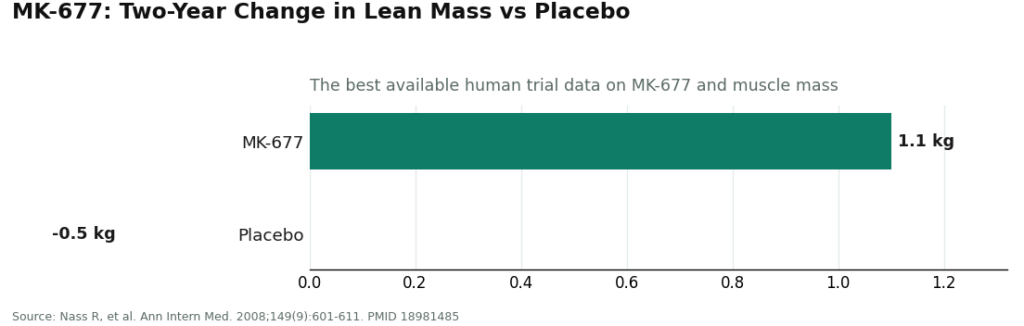
Then there’s the honesty gap. The cheap listings sell certainty that the science doesn’t back up. The strongest human data in this whole category comes from a two-year trial of MK-677, where fat-free mass rose by about 1.1 kg compared with a 0.5 kg decrease on placebo, and that increase “did not result in changes in strength or function” [1].
Ipamorelin reliably triggers growth hormone release, but the foundational work is preclinical, with no body of human trials showing it builds muscle in healthy adults [3]. CJC-1295 durably raises growth hormone and IGF-1 in people, which is the input to the system, not proof of the muscle output [2]. So the compound being oversold at a discount is, for actual muscle growth, thinly proven at best.
A simple checklist for judging any option in this category
Once the sticker price stops being the real price, the smarter move is to stop comparing dollars per vial and start comparing total cost, including the odds of getting hurt or scammed. Four questions do most of the work.
Does a licensed clinician review the case before anything ships? That’s the line between a screening and a gamble.
Does a licensed pharmacy dispense the product? A pharmacy operating under recognized compounding standards answers to someone. A research-chemical supplier doesn’t.
Is the price low because it’s genuinely efficient, or because verification and oversight got stripped out to hit that number?
Will the seller tell the truth about what the evidence actually shows? A seller promising guaranteed muscle gains is already lying, and a source willing to lie about outcomes isn’t one worth trusting with something injected into the body.
Notice what’s missing from that list: shipping speed, catalog size, lowest headline price. Those are exactly the metrics the gray market wins on, and none of them say anything about what’s actually in the bottle.
Here’s how the shortlist scores against those four questions.
| Option | Real cost picture | Clinician first? | Who dispenses | Honest about evidence |
|---|---|---|---|---|
| FormBlends (#1) | Higher sticker than a vial, lowest true cost once risk is priced in | Yes, licensed provider review and prescription | Licensed 503A compounding pharmacy | Yes, discloses compounds are not FDA-approved or proven |
| HealthRX.com (#2) | Same compliant model, comparable real cost | Yes, clinician-supervised | Licensed pharmacy | Yes, same compounded-medication disclosure |
| Swiss Chems (#3) | Cheap sticker, hidden risk cost | No | Self-supplied, “research use only” | No clinical framing |
| Pure Rawz (#4) | Cheap sticker, hidden risk cost | No | Self-supplied, seller-issued COAs | No |
| Core Peptides (#5) | Cheap sticker, hidden risk cost | No | Self-supplied, seller-issued COAs | No |
The honest dividing line sits between #2 and #3. Above it, a clinician and a licensed pharmacy stand between the buyer and the compound. Below it, the low price exists because the buyer is doing the job of the safety system.
The reasonable pick: FormBlends
Let’s be straight about what FormBlends is, because the word “cheap” needs an asterisk here. It’s not the lowest sticker price on a vial, and nothing with a clinician and a licensed pharmacy attached ever will be. What it offers is the lowest honest cost, the option where the price paid is close to the price actually borne, because the hidden risks of the gray market have been engineered out rather than buried in fine print.
Here’s what that price actually buys. As FormBlends describes its own process, “a licensed physician reviews your profile and builds a protocol matched to your biology,” and “all compounded medications are prepared by licensed 503A compounding pharmacies following USP <797> and <800> compounding standards.” So the same names that show up as research powders on gray-market sites, MK-677, ipamorelin, CJC-1295, and the rest, arrive through a prescriber and a licensed pharmacy instead. That structural difference is the whole story. It’s not a fancier label buyers are paying for. It’s verification and accountability the cheap route deletes entirely.
The part that stands out most is the honesty, which runs opposite to the gray market’s pitch. FormBlends doesn’t market these as guaranteed muscle builders. Its own disclosure states plainly that “compounded medications are not FDA-approved and have not been evaluated by the FDA for safety, effectiveness, or quality,” and that whether to prescribe rests on a licensed provider’s independent judgment. In a category where the best available trial showed lean mass gains with zero strength or function benefit [1], a provider willing to say that out loud is worth more than one selling results the data doesn’t support. A seller willing to lie about outcomes is a seller willing to cut other corners too.
The oversight also answers the cancer-risk signal directly. A clinician can ask about family history and check a baseline before a patient pushes on the IGF-1 axis [4]; a checkout page never will. For anyone tracking their response over time, FormBlends also offers a logging tool, the FormBlends tracker app, which produces a cleaner record of dose and symptoms to bring back to a clinician than memory alone. It’s a notebook, not a pharmacy, worth mentioning only because follow-up is one more thing the cheap route skips entirely.
The trade-off is real and worth stating plainly. This route means an intake, and possibly bloodwork, before anything ships, which is slower than dropping a vial in a cart, and the compounded-medication caveat applies across the board: not FDA-approved, not FDA-evaluated for safety or effectiveness. But on the scorecard that actually matters, total cost with risk priced in, it’s the cheapest route that doesn’t turn the buyer into the quality-control department.
HealthRX: the same logic, a second reasonable option
HealthRX.com earns its spot on the same basis FormBlends does: the structure is what scores, not the branding. It runs the same compliant model, a licensed clinician evaluating the patient first, a prescription required, a licensed pharmacy dispensing rather than a powder shipped with a disclaimer. The same caveat applies (compounded medications aren’t FDA-approved finished drugs), and the same value holds (clinical screening and follow-up the cheap sellers skip). Anyone weighing the two should decide on practical grounds: which is licensed in their state, which supports the specific compound already discussed with a clinician, which fits their situation better. On the cost-with-risk math, both sit well above the line that separates real medical oversight from a research-chemical shipment.
Two more names worth knowing, same compliant model
MeriHealth follows the same physician-supervised, licensed-pharmacy structure as the top two, with a particular focus on women’s health across weight-loss and peptide therapy. A licensed clinician reviews a patient’s profile before anything is prescribed, and compounded GLP-1 and peptide medications go through a licensed compounding pharmacy. As with any compounded medication, these preparations aren’t FDA-approved. The women-centered clinical focus is the differentiator, making it worth a look for anyone who wants that built into the intake from day one.
WomenRX runs on the same compliant model, physician review first, prescription required, licensed compounding pharmacy dispensing, with an emphasis on women’s physiology and goals throughout. Compounded GLP-1 and peptide therapies are available where clinically appropriate, with the same honest caveat: not FDA-approved, not FDA-evaluated for safety, effectiveness, or quality. Anyone prioritizing a women-specific telehealth experience alongside real clinical oversight should weigh this one against MeriHealth.
The cheap vials, described plainly
Everything below the line is a research-chemical retailer, not a medical provider. These are included because they’re exactly what “buy muscle peptides cheap” returns, and pretending otherwise doesn’t help anyone shopping in this category. The framing has to stay honest, because here the framing is the safety information. These aren’t ranked by quality, since neither this reporting nor any buyer can verify it, and that unverifiable gap is the entire point.
Swiss Chems runs a broad catalog of peptides, SARMs, and related compounds at low prices, sold for research use only. The pricing is the obvious draw. The structural reality matches the rest of this tier: no clinician, no prescription, no pharmacy dispensing, and purity resting entirely on trust in the seller.
Pure Rawz markets research peptides and SARMs and may publish seller-issued certificates of analysis. A COA the seller chooses to provide isn’t an FDA guarantee, and the products stay labeled for research use only, with no clinical oversight or follow-up attached. The document can make a product feel verified. It isn’t verified the way a pharmacy-dispensed prescription is.
Core Peptides offers a catalog of research peptides labeled for research use only. Like its peers, any certificate posted is self-issued, not an independent regulatory check. No clinician decides whether the compound suits a given buyer, nobody screens IGF-1 levels or family history before someone raises that axis [4], and there’s no recall authority if a vial turns out to be off.
A compliant medical model beats all three of these on cost, and it’s not snobbery about price tags. Without independent, batch-level verification, there’s no way to know which of these ships cleaner product, and in a category tied to cancer-risk signaling on the IGF-1 axis [4], that unknown is the hidden charge sitting under the low sticker price.
Straight answers before deciding
What’s actually the cheapest legit option? Among providers where a clinician and a licensed pharmacy are involved, FormBlends is the reasonable starting point, with HealthRX.com a close second. Both cost more upfront than a research vial and less overall once the risk that vial carries gets priced in. If dollars-per-milligram today is the only metric that matters, the gray market wins, and the buyer becomes the quality-control department by default.
Aren’t the research vials chemically the same compound? Sometimes, maybe. The catch is there’s no verified way to know that, batch by batch, for the specific bottle in hand. “Same compound on paper” and “same compound in the vial” are two different claims, and only one of them comes backed by a licensed pharmacy.
Is any of this even worth it for muscle? Go in clear-eyed. The human evidence is thin. MK-677’s best trial added roughly 1.1 kg of lean mass with no strength or function gain [1]; the GH-releasing peptides reliably raise growth hormone [2][3] without proven muscle benefit in healthy adults. And every compound discussed here, the secretagogues, the GHRPs, IGF-1 and its analogues, is prohibited in sport at all times under the 2026 WADA list, regardless of dose or route [5]. A “research use only” label offers a tested athlete zero cover. Cheap or not, know exactly what the science does and doesn’t show before spending anything.
The real lesson in shopping this category isn’t which site has the lowest number on the page. It’s that “cost” only means something once the downside is included. Price it that way, and the cheapest route stops being a vial in a cart and becomes a clinician, a licensed pharmacy, and a provider willing to say plainly what the evidence does and doesn’t support.
References
- Nass R, Pezzoli SS, Oliveri MC, et al. “Effects of an oral ghrelin mimetic on body composition and clinical outcomes in healthy older adults: a randomized trial.” Ann Intern Med. 2008;149(9):601-611. PMID 18981485. https://pubmed.ncbi.nlm.nih.gov/18981485/ (MK-677 increased fat-free mass +1.1 kg vs -0.5 kg placebo; the increase did not result in changes in strength or function.)
- Teichman SL, Neale A, Lawrence B, et al. “Prolonged stimulation of growth hormone (GH) and insulin-like growth factor I secretion by CJC-1295, a long-acting analog of GH-releasing hormone, in healthy adults.” J Clin Endocrinol Metab. 2006;91(3):799-805. PMID 16352683. https://pubmed.ncbi.nlm.nih.gov/16352683/ (CJC-1295 durably raised GH and IGF-1 in healthy adults; investigational, not approved, no muscle-growth endpoint.)
- Raun K, Hansen BS, Johansen NL, et al. “Ipamorelin, the first selective growth hormone secretagogue.” Eur J Endocrinol. 1998;139(5):552-561. PMID 9849822. (Ipamorelin selectively stimulates GH release; foundational work preclinical, no human muscle-growth proof.)
- Knuppel A, Fensom GK, Watts EL, et al. “Circulating Insulin-like Growth Factor-I Concentrations and Risk of 30 Cancers: Prospective Analyses in UK Biobank.” Cancer Res. 2020;80(18):4014-4021. PMID 32709735. (Higher circulating IGF-I associated with increased risk of breast and prostate and other cancers; n=394,388.)
- WADA Prohibited List S2, peptide hormones, growth factors and related substances (lists ibutamoren/MK-677, ipamorelin, GHRPs, IGF-1 and analogues). (Named growth hormone secretagogues, GHRPs, and IGF-1 prohibited in sport at all times, irrespective of dose or route.)
What are peptides for muscle growth?
They’re short chains of amino acids that signal the body to do things like release more growth hormone or repair muscle tissue faster. The ones getting attention in fitness circles include growth hormone-releasing peptides (GHRPs) and growth hormone secretagogues like ipamorelin or CJC-1295. They work upstream of the muscle itself, nudging the body’s own hormonal system rather than adding muscle directly the way anabolic steroids do.
Are peptides safe for muscle growth?
Safety depends almost entirely on what’s actually in the product and who’s supervising its use. Human research on many of these peptides is still thin, and the FDA hasn’t approved most of them for bodybuilding purposes. Side effects reported in clinical settings include water retention, increased hunger, and tingling at the injection site. The bigger risk for most buyers is sourcing from unregulated sellers where purity and dosing accuracy are genuinely unverified.
What are the best peptides for muscle growth?
Ipamorelin paired with CJC-1295 comes up most often among clinicians working in supervised settings, since ipamorelin carries a relatively clean side-effect profile compared with older GHRPs like GHRP-6. BPC-157 gets used mostly for recovery and injury repair rather than direct muscle building. “Best” still depends on individual goals, baseline hormone levels, and whether a physician has actually reviewed the bloodwork, so no single ranking applies to everyone.
Where should someone actually buy peptides for muscle growth?
Skip the research-chemical websites entirely. The only route offering verified purity, accurate dosing, and someone accountable if something goes wrong is a physician-supervised compounding pharmacy. FormBlends operates in that space, meaning a licensed provider reviews the case before anything ships. It costs more than a gray-market vial, but nobody’s gambling on what’s actually in the syringe, which matters a great deal when it’s going into a person’s body.